Christmas is wonderful, but January credit card bills are not. The good news: a holiday budget doesn’t have to be complicated. You decide one total number, split it into a few categories, give everyone on your list a gift budget and track what you spend.
Here’s how to work out how much to spend on Christmas, with a sample holiday budget and a simple way to save for it before December.
Step 1: Decide your total Christmas budget
Start with one question: how much can I spend without borrowing? Look at your regular monthly budget and see what you can set aside between now and mid-December, plus anything you’ve already saved. That’s your total. If you’d have to put it on a credit card you can’t pay off in January, the number is too high.
Pick the total first and fill in the details second. If you start with the gift list, the budget usually ends up being whatever the list costs.
Step 2: Split it into categories
Gifts are the biggest part of Christmas spending, but they’re not the only part. Food, decorations, cards, wrapping paper, travel and parties add up quickly. Here’s a sample split for a $1,000 holiday budget:
| Category | Budget | Share |
|---|---|---|
| Gifts | $600 | 60% |
| Food & drinks | $150 | 15% |
| Travel | $100 | 10% |
| Decorations | $50 | 5% |
| Cards & wrapping | $50 | 5% |
| Events & charity | $50 | 5% |
| Total | $1,000 | 100% |
Your split will be different. If you’re hosting Christmas dinner, food gets more; if you’re staying home, travel might be zero. The point is that every cost has a place in the plan.
Step 3: Give everyone on your list a gift budget
Now divide the gift money between the people you’re buying for. Writing a number next to every name is the single best way to stop overspending, because you can see immediately when one gift eats into someone else’s budget.
| Who | People | Budget each | Total |
|---|---|---|---|
| Partner | 1 | $150 | $150 |
| Kids | 2 | $100 | $200 |
| Parents | 2 | $50 | $100 |
| Siblings | 3 | $30 | $90 |
| Friends | 4 | $15 | $60 |
| Gifts total | 12 | $600 |
Add gift ideas and where to buy them next to each name, and update the status as you go: idea, ordered, bought, wrapped. In December you’ll know exactly what’s done and what’s left.
Step 4: Save for it before December
Spreading the cost over a few months makes Christmas much easier. Divide your total by the number of weeks until you start shopping:
| When you start | Weeks to save | Per week for $1,000 |
|---|---|---|
| Start in early October | 12 | $84 |
| Start in early November | 7 | $143 |
| Start in mid-November | 5 | $200 |
Move that amount into a separate savings account every payday. When December comes, the money is already there. If you start saving in January for next Christmas, $1,000 is about $20 a week.
Step 5: Track every purchase
A budget only works if you compare it with what you actually spend. Write down each purchase as you make it, including the small ones like wrapping paper and batteries. Check your totals every week so you can adjust early, not on Christmas Eve.
10 ways to spend less on Christmas
- Suggest Secret Santa for big families or groups of friends: everyone buys one nicer gift instead of many small ones.
- Agree on a spending limit with friends and siblings.
- Shop with a list. Black Friday deals only save money if the item was already on your list.
- Buy early. Last-minute shopping is where budgets break.
- Give experiences or homemade gifts: a day out, a cooked meal, baked goods or a photo book.
- Reuse decorations and skip new ones this year.
- Plan the Christmas menu and buy food with a shopping list.
- Send e-cards to people you only exchange cards with out of habit.
- Set a budget for kids’ gifts and stick to it, even when the wish list grows.
- Use cash or a debit card for holiday shopping, so you can’t spend money you don’t have.
Plan your Christmas in one spreadsheet
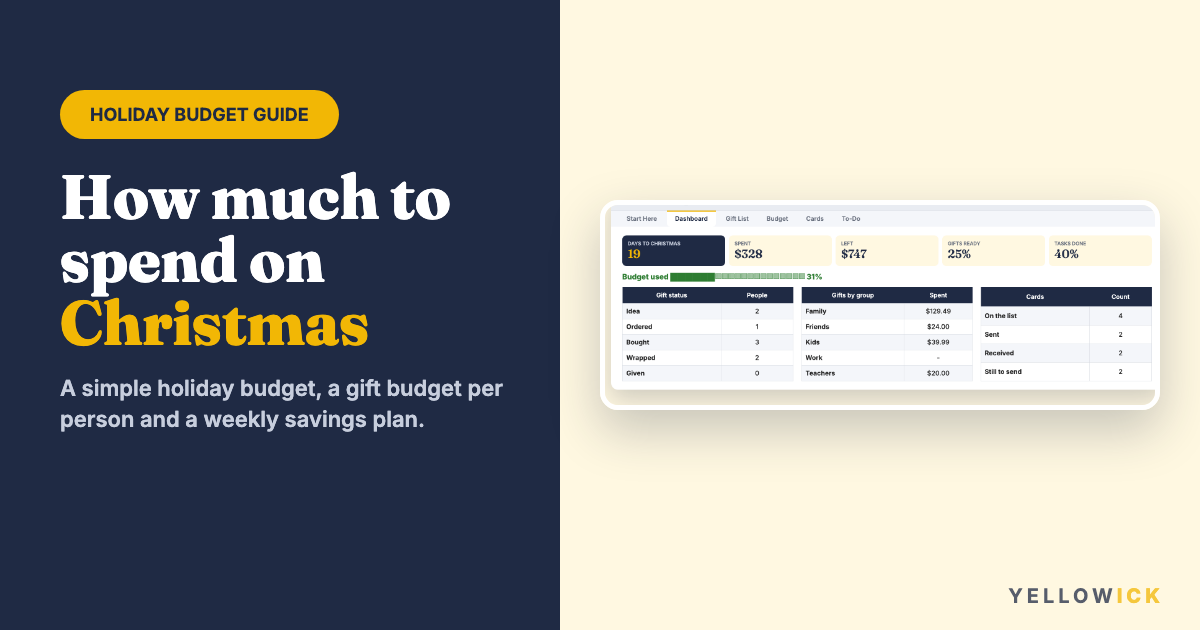
You can do all of this on paper, but a spreadsheet adds everything up for you. Our Christmas Planner & Gift Tracker for Google Sheets and Excel has a gift list with a budget per person, a holiday budget by category, a card list and a to-do list, plus a dashboard with the days to Christmas, what you’ve spent and how much is left.
Want to get the rest of your money organized for the new year too? The Budget Planner 2027 helps you plan every month, including a savings line for next Christmas.
🎁 Free monthly budget template
Want to try this in a spreadsheet? Get our free one-month budget template for Google Sheets and Excel, with budget vs actual and an automatic 50/30/20 check. Get the free template →
Frequently asked questions
How much should I spend on Christmas?
There’s no right number for everyone. A good rule is to spend only what you can pay for with money you have or can save before December, without cutting essential bills or using credit you can’t pay off in January.
How much of my holiday budget should go to gifts?
Gifts are usually the biggest category. In the sample above they’re 60% of the total, and the rest covers food, travel, decorations and other costs that are easy to forget.
How much should I spend on each person?
Start with your total gift budget and divide it by the people on your list, giving more to your closest family and less to friends and colleagues. If the numbers get too small, it’s a sign to suggest Secret Santa or a spending limit.
Should I use a credit card for Christmas shopping?
Only if you can pay the full balance when the bill arrives. Interest on holiday spending can last well into the new year.
This article is for general information only and isn’t financial advice.