A new year is the easiest time to get your money organized. You don’t need a finance degree or an app subscription to do it. A budget is simply a plan for your money: what comes in, what has to go out, and what you want to do with the rest.
This guide walks you through how to make a budget for 2027 in 7 simple steps, with a sample monthly budget you can adapt to your own numbers.
Step 1: Work out your monthly take-home income
Start with the money that actually lands in your account each month, after tax and other deductions. That’s the number you can spend, save or use to pay off debt.
- Regular salary: use your net pay from your payslip.
- Paid every two weeks: most months you get two paychecks, but two months a year you get three. Budget with two and treat the extra paychecks as a bonus for savings or debt.
- Irregular income (freelance, side hustle): look at the last 12 months and budget with your lowest typical month, not your best one.
Step 2: List your fixed bills
Next, write down every bill that comes back each month or each year: rent or mortgage, utilities, phone, internet, insurance, subscriptions, loan payments. Note the amount and the due date.
Don’t forget the bills that only come once or twice a year, like car insurance or a yearly subscription. They’re the ones that usually wreck a budget. A simple bill tracker with due dates helps you see them coming.
Step 3: Look at what you actually spend
Open your bank and card statements for the last two or three months and group your spending into categories: groceries, eating out, transport, shopping, entertainment and so on. You’ll probably be surprised by at least one of them. That’s normal, and it’s exactly why this step matters: your budget should be based on real numbers, not guesses.
Step 4: Choose a budgeting method
There’s no single right way to budget. These three methods are popular because they’re simple:
- The 50/30/20 rule: about 50% of your take-home pay goes to needs, 30% to wants and 20% to savings and extra debt payments. It’s a great starting point if you’ve never budgeted before.
- Zero-based budgeting: you give every dollar a job until income minus spending, saving and debt payments equals zero. It takes more effort but gives you the most control.
- The envelope method: you set a fixed amount for each spending category and stop when it’s used up. It works well for categories you tend to overspend on, like eating out.
You can also mix them: use 50/30/20 as a quick check, and zero-based budgeting for the details.
Step 5: Set a budget for every category
Now turn your numbers into a plan. Here’s a sample monthly budget for a take-home income of $4,000, using the 50/30/20 rule as a guide:
| Category | Group | Monthly budget |
|---|---|---|
| Rent | Needs | $1,200 |
| Utilities | Needs | $150 |
| Groceries | Needs | $400 |
| Transport | Needs | $150 |
| Insurance | Needs | $100 |
| Dining out | Wants | $250 |
| Entertainment | Wants | $150 |
| Shopping | Wants | $200 |
| Subscriptions | Wants | $50 |
| Travel fund | Wants | $300 |
| Hobbies and other | Wants | $250 |
| Emergency fund | Savings & debt | $300 |
| Retirement | Savings & debt | $200 |
| Extra debt payment | Savings & debt | $300 |
| Total | $4,000 |
That’s $2,000 for needs (50%), $1,200 for wants (30%) and $800 for savings and debt (20%). Your own split will look different, especially if rent is expensive where you live. That’s fine. The goal is a plan you can actually stick to.
Step 6: Plan for irregular expenses
Some costs don’t show up every month, but they’re not a surprise either: car insurance, car repairs, holidays, birthdays, school costs. Add up what they cost in a year, divide by 12 and set that amount aside every month. These are often called sinking funds.
| Expense | Per year | Set aside per month |
|---|---|---|
| Car insurance | $1,200 | $100 |
| Holidays and gifts | $600 | $50 |
| Car maintenance | $480 | $40 |
| Total | $2,280 | $190 |
When the bill arrives, the money is already there, and your budget doesn’t fall apart.
Step 7: Track your spending and review every month
A budget only works if you check it. Log your spending as you go (or once a week), and take 15 minutes at the end of each month to compare your budget with what you actually spent. Ask yourself:
- Which categories went over, and why?
- Is there a category I always underspend that I can move money from?
- Did I save what I planned?
- What should I change for next month?
Most people need two or three months to get their budget right. Adjust it, don’t give up on it.
Paying off debt? Put it in the budget
If you have credit card or loan debt, make the extra payment a fixed line in your budget, like in the sample above. Two popular payoff strategies are the debt snowball (pay off the smallest balance first for quick wins) and the debt avalanche (pay off the highest interest rate first to save the most money). A debt payoff tracker can show you your debt-free date for both methods, so you can pick the one that suits you.
Common budgeting mistakes to avoid
- Making the budget too strict. Leave some money for fun, or you’ll give up by February.
- Forgetting yearly bills. Use sinking funds so they don’t catch you off guard.
- Budgeting with your best month. Plan with a realistic, average or lowest month instead.
- Not having an emergency fund. Even a small buffer stops one surprise bill from turning into debt.
- Setting it and forgetting it. Review your budget every month.
Make your 2027 budget in a spreadsheet
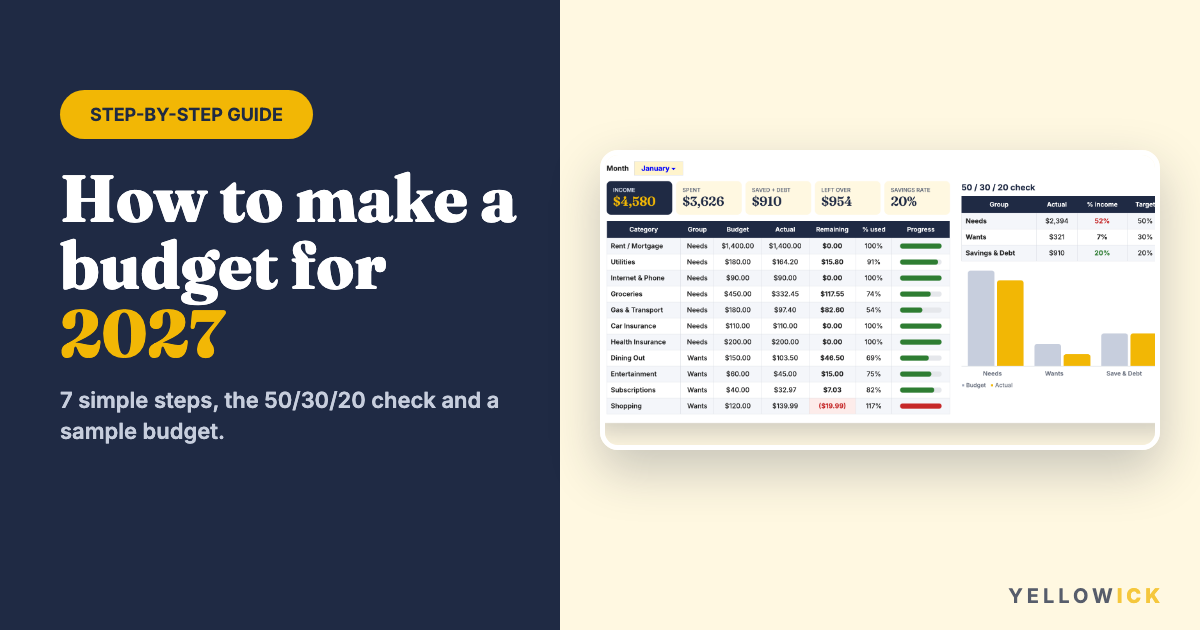
You can build all of this with pen and paper, but a spreadsheet does the math for you. Our Budget Planner 2027 for Google Sheets and Excel follows exactly these steps: set a budget for every category, log your transactions, and see budget vs actual, your 50/30/20 split and your savings rate for every month, plus a full-year overview.
Want the full system? The Finance Planner Bundle includes the Budget Planner, the Debt Payoff Tracker and a Savings Goal Tracker with a 52-week money challenge.
🎁 Free monthly budget template
Want to try this in a spreadsheet? Get our free one-month budget template for Google Sheets and Excel, with budget vs actual and an automatic 50/30/20 check. Get the free template →
Frequently asked questions
How much of my income should go to rent?
A common guideline is to keep housing costs around 30% of your income or less, but in many cities that isn’t realistic. If rent takes more, balance it by spending less on wants for a while.
How much should I have in an emergency fund?
Many people aim for three to six months of essential expenses. If that feels impossible, start with a smaller goal, like one month of expenses, and build from there.
Is the 50/30/20 rule right for everyone?
No. It’s a starting point, not a strict rule. If you have a lot of debt or high living costs, your split might look more like 60/20/20 or 70/10/20. What matters most is that you save something every month and don’t spend more than you earn.
This article is for general information only and isn’t financial advice.